Exterior Designs

Next week, the Transport Planning Society is holding ‘Transport Planning Day’ and presenting a People’s Award to a “local transport planning initiative” nominated by the community for the positive impact it has had on their neighbourhood. Among the short list is a vintage bus, a ‘parklet’, and a rather lovely pedestrian-cycle bridge over a gorge.

Last week, I attended a seminar about the project Use-It that recruited community researchers and asked them to find out what their neighbours really felt about their built environment, and then act as liaison between their communities and the local Council, developers operating in the area, the University and other stakeholders. Some of the results included a desire to redefine planning conditions on outdoor play areas, create a food-based social enterprise, and ensure the connectivity of a major new development to existing streets and paths.

And in between, I’ve been catching up on a favourite television programme: Grand Designs. Which got me to thinking, Grand Designs has a lot to say about the architecture of the homes it showcases, including the buildings, facades, interior design, and landscape design. It also philosophises about the architecture in terms of integrity, sustainability, function, and aesthetics. Yet, whilst the surrounding environment of the building and any views and constraints they may offer are referenced, there is no discussion of the design beyond the property boundaries, the exterior design.

On the other hand, exterior design is very much what the Transport Planning Society’s People’s Award, the Use-It project, and indeed transport planners, community activists, and many others with civic concerns are all about.

I call it exterior design instead of urban design because urban design is rarely considered part of transport planning or vice versa. It excludes more rural or even ‘small town’ places. And although urban design does have roots in architecture, I have rarely heard it expressed in the philosophical tones presenter Kevin McCloud employs so well, that great design has to reflect the people who invest in it and make it and live in it.

Is it any wonder that the projects shortlisted for the People’s Award and chosen by the community researchers are people-focused, not building / vehicle oriented? Is it a surprise that the aesthetic of a vintage bus or a green oasis in place of a parking space or a beautiful bridge have more appeal than widening motorways or reprogramming traffic signals? Is it so unexpected that communities faced with a large new development are most concerned about play areas, pedestrian paths, and the potential for locally-sourced food?

No, because there is the same instinctive attraction to such projects and places and spaces as there is to ideas of child-friendly cities that I wrote about back in the summer.

There are, of course, many challenges in reflecting not an individual or a family, but a whole community, and doing so not in a single dwelling, but the public realm. But starting with abstract numbers of people movements and vehicle flows does not result in great exterior design.

The recent mantra is we need to do more visioning in strategic transport planning, for both big infrastructure, as well as local area enhancements. So why not make the task easier by waxing philosophical about how we want public spaces, transport spaces to look and feel, rather than assume a vision needs to be couched in abstract policy terms. Maybe there is something to thinking about form over function? Kevin would probably say that a good form is one that will function well.

At the very least it could help broaden the sorts of discussions with communities that the People’s Award and the Use-It project were designed to instigate. A discussion about transport planning indirectly, a discussion about exterior design.


Transport for Women

It’s been bothering me that I hadn’t written a blog for October, when I usually write them at the beginning of the month, but at the beginning of the month I was in a bit of a funk.

A big part of that was politics and current events, namely the Brett Kavanaugh nomination to the Supreme Court after he was accused of sexual assault and harassment. I read the news regularly, and am interested in politics, but I try to keep my emotions at an arms-length. It would be too easy to let it all get to you when the positive so rarely features, especially in the last couple years. But this news really got to me, upset me, as a woman. Considering all the other #MeToo stories, I wasn’t sure why.

I have never, thank God, been sexually assaulted. The closest I could come to what Kavanaugh’s accusers described was a memory of a man exposing himself to me. Not at a drunken frat party, but when I was about seven, riding around my neighbourhood on my bicycle. A car pulled up and a complete stranger flashed me. I sped the other way so fast, I might have left the block faster than he did. My mother called the police and I had to describe what had happened. Which wasn’t much. I don’t know if they ever caught him. I’ve rarely thought about the incident since, nor could I say it has affected my life.

And yet, I am a transport planner, and the whole thing was intimately (pun intended) tied up with modes of transport; the more powerful, the more entitled preying upon the more vulnerable. I love my chosen profession of transport planning, but as a woman in a male-dominated profession, the metaphors of female subordination in transport are often just below the surface. And it’s that contrast of entitlement and assumed subordination that upset me most in the Kavanaugh case.

However, having recently read an article in the Times about a former Google employee, Sarah Cooper, who has turned to stand-up comedy and writing tongue-in-cheek tips (and books) on how women try to get ahead by pleasing and pacifying men, I’ve been cathartically inspired to write a few ideas in the same tone. Perhaps I can thus make the argument that women are not only well suited to working in transport, but should feel entitled to work in transport!

Here goes:

  1. Boats, airplanes, and cars are all often referred to with female pronouns, so surely females will know best how to plan for them.
  2. Trains might sometimes have male names, but most would say girls are best at staying within the lines.
  3. If the fastest female athletes are slower than the fastest men, slow modes must be our thing too.
  4. We’re the only half of the species biologically designed to carry a foreign body for 9 months at a time – it makes us naturals in long-term logistics.
  5. Women make up the majority of professional models, so why not modellers?
  6. There must be a reason car insurance for young women costs much less – an instinct for road safety that young men can only hope to learn?
  7. Community engagement and public involvement require empathy and emotional intelligence, which women are supposed to be over-endowed with.
  8. From buggy pushers to tartan trolleys, we can definitely deal in accessible planning for the whole life-cycle.
  9. Ever heard of women’s intuition or that a woman always changes her mind? Not so great for fixed forecasts, but in a world of technological change and uncertainty, the womanly tasks of visioning and scenario planning are on the rise.

But what about that technological change? Technology is a professional discipline, like transport, where women trail men. But then Sarah Cooper made it, and moved on to make jokes about being a female tech professional that have launched her comedy career. I don’t claim to be a comedienne. And there’s always the danger that patronising too can be disguised as joking. But perhaps a bit of humour will help women in transport move from the trailer into the driver’s seat too?


Slow down, you move too fast…

As children head back to school, the weather changes, and Jewish people look forward to celebrating their new year, it feels as if life is speeding up again after the long, (and even in the UK!) hot days of summer. Transport policy, with its tendency to assume sleek new technology will solve all our transport problems, also seems to assume that speeding up is inherently a good thing. That shared, electric, autonomous, and motorised mobility plus immediate information available anywhere will increase road safety, reduce emissions, free up road space, and help move the growing population of elderly and disabled around more easily.

And yet, does the population, elderly or otherwise, actually want to always move faster and further? It seems to me that the Future of Mobility call for evidence, whilst acknowledging that people are travelling less, commuting less, and driving less, only considers how information and communication technologies are changing attitudes to transport information and accessibility. Yet the high-tech accessibility of information is changing not just attitudes, but accessibility itself – how we obtain goods and services, how we participate in activities and opportunities. The consultation document mentions telecommuting, but not online shopping, which is likely one reason van traffic is growing so fast, nor does it consider the advent of other tele-services, such as tele-healthcare.

My point is that technology can mean faster and further and more frequent OR it could mean fewer, more flexible trips. It could push us all to operate like machines or it could serve to help us keep things human. There could be accessibility as a service instead of mobility as a service, meeting people’s needs by meeting them halfway. The sharing economy could be finding groups of families to share the school run between busy parents, whilst still enabling their kids to walk to school. Or perhaps technology can match not passengers, but patients who will can share the walk to the doctor’s office to improve their own health by not only increasing physical activity, but reducing loneliness and fear.

Maybe that vision is idealistic, but surely it’s more appealing than the transport-tech-optimism that seems to suggest we should be shaping our cities to accommodate driverless, and perhaps empty, vehicles, rather than living, breathing people. Besides, once we stop valuing speed of travel over quality of life, we may have a better chance of making these new technologies work for people and places, rather than as ends in themselves.

My New Year’s resolutions this year are all about making the moment last.1 I aim to be more patient, to default less to that overused excuse of being ‘stressed’, to savour the change and growth this new year promises to bring to my family and to me. Oh, I’m sure we’ll all be doing lots of different activities, getting work done, moving around. And some of that movement will require covering long distances quickly. But day to day, we will often be walking, interacting with each other and the environment, thinking and learning.

In my own small way, as a representative of transport professionals and a researcher into the opportunities technology may bring for future mobility and accessibility in a changing climate, some of the thinking and learning I will be doing when I am taking it slow will be about a future vision of technology and travel that supports quality of life. And that might mean the technology offers ways to slow down.


1The title of this blog and this line are from Simon and Garfunkel’s Feeling Groovy.

Hot Options

As the recent unprecedented heatwave comes to an end, at least temporarily, it seems a good time to reflect on how hot, sunny weather might affect travel behaviour.

Unlike wind-driven storms or winter weather which have much more direct and obvious impacts on transport infrastructure, the physical impacts of heatwaves on roads and public transport are more diffuse. Steel rails may buckle, tarmac occasionally melts, and fewer people may be allowed to crowd onto the London Underground carriages, but mostly roads and services are available for normal use (barring planned engineering works, resurfacing and other construction that often is scheduled in the summer). The heat and talk of beaches and barbecues may make the headlines, but travel disruption much less so. Even where heat and drought result in forest fires, they rarely affect major routes.

Yet heat itself can still be an extreme type of weather as much as cold or wind or rain. And people do change their travel behaviour based on the weather, especially extreme weather. Various studies have shown decreases in trips by different modes in adverse weather. And in countries which regularly experience extreme heat, another study recorded decreases in active travel once temperatures pass a certain threshold.

However, it is not regular for the UK or many of the other countries that have been affected by this summer’s heatwaves to experience extremely hot weather. That makes it difficult to hypothesise how people might respond in terms of travel behaviour. Especially as these heatwaves are only extreme in relative terms – temperatures are still not reaching the levels common in tropical or desert countries, so it is not necessarily too hot for people to walk, bicycle, or otherwise want to be outdoors and enjoy the weather when they travel. Alternatively, the lack of familiarity with such weather may result in people struggling to adjust and seeking travel spaces that are air-conditioned, mainly cars, but also, in some areas, a subset of public transport services.

Or it may depend on where people are going or where they live. How comfortable are different houses or apartments in the heat? How about offices or shops? Are private gardens or public parks more readily available? Which are more likely to provide relief from the even hotter microclimates of urban streets? The answers to such questions may suggest less travel altogether, but the possibility of empirical, quantitative evidence to support this is confounded by yet another factor. Holidays.

Days of extreme heat occur in the summer, when there are often fewer regular, short-distance trips and more long-distance travel for leisure purposes. People often plan such trips well in advance and can’t change travel arrangements nimbly. Thus, families with school children, those who work in education, and various other groups are likely to change their travel behaviour in the summer no matter what weather summer brings. There is consistently less traffic during summer school holidays. There is also usually more walking and cycling, more sporting events and festivals. Such activities are often only cancelled for electrical storms or other immediate dangers; unusual heat or drought is not among these dangers.

Still, even if current travel behaviour during heatwaves cannot easily be tracked, that does not mean that we should not use this unusually long heatwave to try to monitor how people have responded. Nor does it mean we should not work to adapt our transport networks to the likelihood of future, more frequent hot weather. We could stress our steel rails to higher temperatures and ensure we use appropriate aggregate mixes to prevent melt, but also we could provide more public water fountains and street trees to help people walking and cycling to re-hydrate and cool off. I have written before that one way forward for resilience is ‘monitor and adapt’, and this summer provides a perfect opportunity to start such a process.

#urbanchildhoods

Think of somewhere that was special to you when you were a child. Was it outdoors? Was there an adult present in your memory? For most, at a presentation on the Cities Alive report by Arup, the answers were ‘Yes’ and ‘No’ respectively.

Perhaps because of my awareness of the agenda to get kids walking and cycling and the campaigns for ‘free-range kids’ or what the report calls ‘everyday freedoms’, my first thought was not of a place, but of a journey. My walk to primary school in the 1980s. Like previous generations, from the age of 6, I walked to my local primary school, sometimes in the company of children two or three years older, but rarely with an adult. My daughter’s primary school does not let a child leave the school site without an adult until they are 10 or 11. Thus my daughter’s confusion when I read about the 1950s school children in the Ramona books by Beverley Cleary. Everything else she could relate to, but not this idea that children were allowed to walk themselves to Kindergarten.

For most others at the presentation, however, the memory was of playing in the street. I don’t remember doing that. The driveways, front and back yards of my American childhood were large and open, with rarely a fence or hedge between them. There were sidewalks and verges between us and the road. The key was being allowed to cross the road on our own to play with kids who lived across the street.

By the time I was 8, I was allowed to play with kids on other blocks or to walk to the park without an adult, 4-5 blocks away. At 10 or 11, I could walk downtown, using the signalised cross-walks, and hang out with friends on the busy Main Street. At 13, when I went with my family into Boston, MA, I was allowed, along with my invited friend, to wander around independently for a couple hours once a meeting time and place was arranged.

So in my ‘urban childhood’ (hometown population: 75,000), the everyday freedoms were all important. The independence to wander about, on foot, without adult supervision was all I wanted. I loved to play what my daughter calls ‘walk and talk’ with a close friend. But whereas we used to stroll along city blocks, through the park, from one family household to another, at almost 7, she has so far only played ‘walk and talk’ going in circles round the school playground.

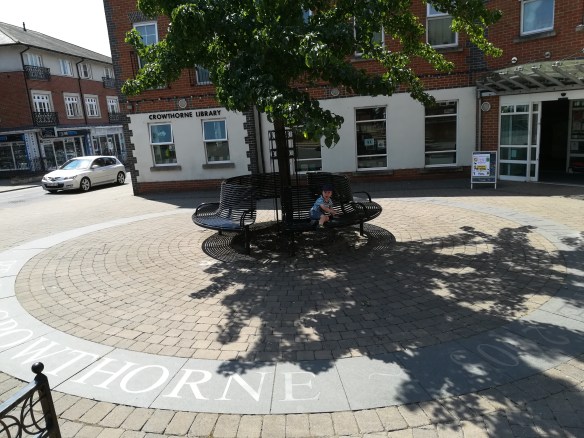
Meanwhile, my son, just finishing pre-school, has an even smaller circle to circumscribe:

IMG_20180706_122231_resized_20180708_105726203

At least that’s a great piece of children’s infrastructure: a circle to run around, benches to climb on, a tree to hide beneath… and right outside the local library too.

Yet primary school age children are not given the everyday freedom to use this space unsupervised. The excuse would be because it is on the busy High Street. But the High Street is a 20mph zone with plenty of traffic calming. And 1950s small-town America had plenty of busy roads for Ramona and her friends to contend with.

So whilst there are many cities with traffic-swamped, dangerous, and unwelcoming places and many positive recommendations in Cities Alive for children’s infrastructure, for my children at least, I see the major barrier as a risk-adverse, somewhat intolerant culture that suggests children are not responsible enough to be unsupervised and have everyday freedoms. Perhaps we need to remind everyone of the independence they had as children, and that only they can make part of their own children’s inheritance.

Monitor and Adapt

In my research, I’ve been thinking a lot about how people might respond to storms, snow, or other severe weather events in a more resilient way to avoid delays, disruption, and risks to personal safety. I’ve been analysing data and searching for evidence of existing resilient responses and considering how more people might be encouraged to follow suit. However, the ‘people’ I have in mind are commuters, ordinary households, the so-called ‘general public’.

Yet at the Local Government Transport Advisory Group President’s Conference at the end of May, I was reminded of the role of a different group of people. The people who have a responsibility to the community to minimise the risk to life and property of any emergency, to react and recover from the disruption, damage, and danger that not only severe weather, but also terrorism, accidents or other unforeseen events might cause. These people include the emergency services, obviously, but they also include local government officers, people responsible for transport, energy, and digital infrastructure and services, social care and hospital staff, even the local media who help disseminate important messages and warnings.

It may not be the ‘general public’ but that’s a lot of people to coordinate. And we heard, with examples, how important it is that all these different people and services are working together in an emergency, have a ‘joint understanding of risk’ and a ‘shared situational awareness’. Without organised collaboration, mistakes are made, and in some cases, more lives are lost.

Yet resilience is not just response and recovery. It is also adaptation and preparation. And when it comes to planning for security and resilience, I learned that there are risks to sharing too much. Too much data can be open to ‘hostile reconnaissance’. Too much planning for specifics is sure to miss something or someone. Too many warnings might be a bit like the boy who cried wolf.

Rather, the advice was to plan based on generic principles. Before opening up data, consider what it can be used for and linked with. Design adaptations with dual functionality. Do have a nominated individual in every organisation responsible for understanding the interactions between physical, personnel, and cyber security and making policy decisions. Don’t have a single individual designated as the only one who can make emergency decisions.

So what does all this have to do with my research? Resilience planning is closely linked to the current debate in transport planning circles around future uncertainty in the field. Uncertainty around the role of new technologies, uncertainty around trends and forecasts, uncertainty around risks and responsibilities. There have been various proposals to replace ‘predict and provide’ with ‘scenario planning’, ‘decide and provide,’ or ‘vision and validate’, which means that the starting point should be policy and a vision of the future we all want to live in, and then we should plan for that future and evaluate whether we are achieving it on an ongoing basis.

Yet to these tidy phrases, I’d add another one I heard for the first time at the conference: ‘monitor and adapt’. If responsible professionals and researchers monitor and review what happens during various types of extreme events in different places and at different times, then we can design adaptations which offer multiple options for resilience. We can prepare and share unified messages, rather than specific data, to generate a more resilient response in the next emergency situation.

In the past, transport planners have tended to monitor what happens on ‘average’ days to plan for future certainties. Now there is a drive to consider future uncertainties, which are partly due to the internal pressures of increasing flexibility and variability in work and travel patterns, and partly due to external events that require resilience. For the latter at least, ‘monitor and adapt’ seems the best approach to take. And with such an approach, transport planners might do their part to help that list of responsible people on the front line of an emergency.

Smarter Future Choices

Did Smarter Choices programmes make us smarter? Did personalised travel planning change personal travel behaviour? Did pilots, challenges, and temporary designations leave a lasting impression? These were the sort of questions my fellow transport professional @jamesgleave1 was asking in his blog of mid-March. His answer was, over time, a qualified not quite, a methodologically minimal.

One of the reasons he gave for his scepticism included the impossibility of disentangling any results from other changes to the accessibility offer. One of the reasons for moderating his response was the valuable discovery of links between travel behaviour choices and changes in other aspects of life, even if the presence of such links further diminished the attribution of impacts to Smarter Choices programmes themselves. Yet this got me thinking that if the debate around Smarter Choices is due to an inability to isolate its impacts, especially longer term, maybe we should start embracing its interactions. Surely Smarter Choices can build on existing trends, encourage any seeds of sustainability to grow without trying to plant them in the first place.

More people are living in cities with access to frequent public transport. Younger generational cohorts are delaying licence holding and car ownership, and are making fewer trips per capita. Surely these are trends on which we could build a Smarter Choices extension, focusing our information and incentives on younger, more urban audiences. Indeed, if younger people are spending their precious disposable income on devices instead of driving, all the more reason to put all that information and those incentives into mobile apps that integrate accessibility planning (including remote and virtual options!), real time information and alerts, fitness tracking, gamification… and perhaps booking and payment as well. The latter brings us to Mobility as a Service, which could be the next Smarter Choices, and indeed, most of the list in the last sentence is already available in one form or another, but is it integrated? Is it being developed to achieve Smarter Future Choices?

Another trend is that more and more jobs and occupations are becoming temporally and spatially independent from traditional workplaces, and the links between commuting distances or cost and residential location choice is weakening. So from travel planning to journey planning, we need to incorporate the geography of ICT supply and demand, and build on the ever-increasing flexibility of the modern economy and the potential for improving resilience that comes from such flexibility. In other words, there are ever more people working from home 1-2 days per week, so transport planners should nourish the trend. Surely Smarter Future Choices are being made if the proportion of car commuters who work from home once a week increases by 20%. Such a target would be easier to achieve than a 20% switch of car commuters to a sustainable mode of travel to work. In fact, previous rounds of Smarter Choices programmes may well have had such an impact, but this trend is poorly monitored by long-term surveys. Tracking this flexibility will be key to judging the success of such Smarter Future Choices.

Finally, Smarter Future Choices could offer daily flexibility via the technology at which younger generations are so adept, and increase awareness of the options urban places can offer. If done properly, this approach could result in so much more than a one-off intervention. It could result in the ability of travellers to decide daily what will not only be their most sustainable option, but also their most convenient, resilient, and productive option, no matter the day of the week, time of the day, weather or season – the smartest option is theirs to take.


A Haggadah for Transport Planning

To continue my self-imposed tradition, this is the time of year when I wish a Happy Passover to all the closeted transport planners of a Jewish persuasion out there by writing a blog that brings Passover and transport planning together.

Over the last four years, I tended to focus on the story of the Exodus, but this year, I thought I’d look at a different aspect of the holiday: The Haggadah, that all-important booklet that provides the Order for the Seder. Or the Order for the Order. For Seder literally translates as Order, which, considering the chaos that often attends the Passover prayers, festivities, and food of which Jews partake around the dinner table with friends and family, ‘order’ may seem a bit of a misnomer (especially in my family?!). But a good Haggadah can make sense of the occasion. Likewise, good transport planning aims to make sense of the cacophony of spaces we travel through and the ways and means by which we do so.

What specific parallels can I find between transport planning and a Haggadah? Four is an important number during the Seder. The proceedings are punctuated by four cups of wine representing God’s four promises of freedom and redemption. Four is an important number in transport planning too. For example, besides the various debates around accommodating two-wheeled and four-wheeled vehicles, transport modelling is traditionally divided into four – trip generation, trip distribution, modal split, and trip assignment.

I can also imagine breaking the middle matzah and hiding half for the children to find as an afikomen to be a metaphor for filtered permeability – breaking up the road network for children and others who cannot drive so they can find more routes safely open to them. And what about the Hillel sandwich? Transport planners often have to think about balancing space for different groups, just as we balance the bitter with the sweet in that symbolic food.

The most important parts of the Seder, however, are telling the story and having the festive meal. It is important too that transport planning has a narrative about place, community, and connectivity. Like in the Haggadah, where the story starts with the four questions, any transport planning narrative should start by questioning how assumptions and standards actually apply in what are often different, if not unique contexts. And just as the festive meal brings the whole family or congregation together, so transport planning should deliver places that everyone in the community can partake of and connections that allow everyone to have their fill of access to what they need and options to get there.

Finally, towards the end of the Seder, we open the door for the prophet, Elijah, in hopes that he will herald a better future. Likewise, if transport planning is to be a success, then any order or organisation which it brings to the myriad of movement made by people and goods must be future-proofed and help us to a better future. So a transport planning Haggadah might conclude with the prayer of ‘Next year in a sustainable transport paradise!’

#NPPFlaunch – the transport take

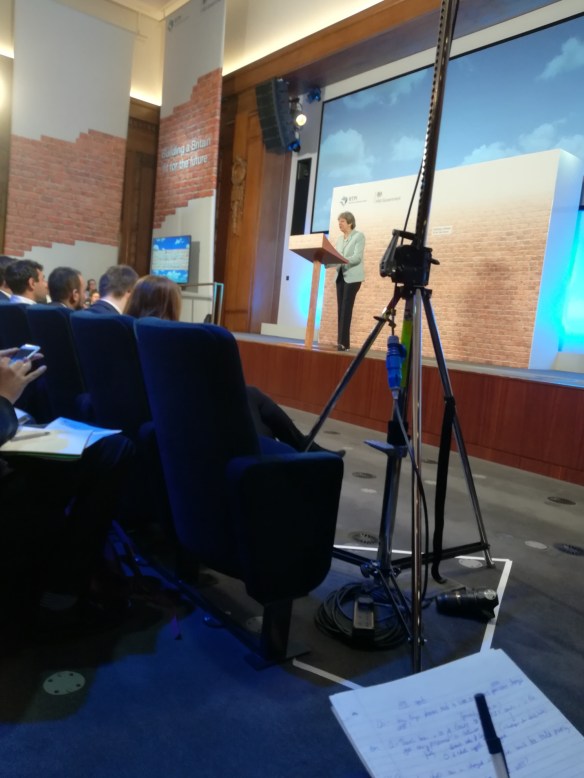
IMG_20180305_103852_resized_20180307_084743602After spending the best part of three hours to travel less than 40 miles (don’t you love rail replacement buses with incredibly unrealistic timetables), I found myself in a slightly surreal position among members of the press with a front row seat for a speech from Prime Minister Theresa May.

I was at a conference jointly organised by the Ministry of Housing, Communities and Local Government and the Royal Town Planning Institute (RTPI) to [re]launch the National Planning Policy Framework. The PM was there to explain how this revised policy would address the national housing crisis. Presumably, I was invited as a long-time RTPI Member and current Chair of their Transport Planning Network.

Not that transport was specifically mentioned by the Prime Minister or Secretary of State, and it was hardly mentioned in the technical sessions or during my casual chats during the long ‘networking’ lunch. I understand it was on at least one slide during the technical session on development locations – my late arrival meant that I had not been able to register for that most popular of sessions – and yet, looking around at people’s badges, I didn’t see job titles suggesting that many transport planners were there to take away any messages that might have been given.

This frustrates me as much as the lack of land use planners at transport events which I have attended in the past year. Transport infrastructure is, more obviously than other types of infrastructure, the warp on which the weft of the built environment is woven. It is the gravy which holds the stew together. Public land, known legally as ‘highways’ that include carriageway, footway, verge, parking spaces, street furniture, and more, make up the majority of what happens in between the private property boundaries, or in other words the ‘buildings’, of our settled, planned places.

And yet the prime minister made far more mention of open space – and preserving the openness of Green Belt land – than she did of the spaces between the 300,000 new houses per year they are planning to build. Perhaps this is because the transport-related changes in the new draft of the NPPF out for consultation are more minor than those relating to the natural environment? It still seemed like there were missed opportunities.

The section in the updated NPPF on sustainable transport is re-structured, with an emphasis on incorporating and engaging with transport planning at the outset, which is encouraging, yet there are no references to the Local Transport Plan or joint spatial plan-making. Some authorities do this anyway, but surely national policy should clearly link the disciplines?

Fortunately, the ill-defined ‘commuter hubs’ proposed in previous consultations are absent, and local discretion is encouraged in identifying places “well served by public transport” to apply density standards. This suggests local transport and land use planners will be given more freedom to decide how to define a transport hub with appropriate capacity and surround it with appropriate development. Unfortunately, local planners are not supported in this endeavour by the barely revised paragraphs in the NPPF on parking. These, whilst less antagonistic about parking charges and enforcement than previously, are more direct with regard to scorning maximum parking standards, despite the success of such policies in the past and the potential for such policies to better provide for a future of electric, potentially autonomous vehicles that are more likely to be shared than owned.

Still, at the conference and in the document, local governments are no longer scapegoats and planners of all types are given more recognition for their ability to create better places. There is even recognition that sustainable transport is about creating “places that are safe, secure and attractive” that “respond to local character and design standards”. And creating such places should be exactly what all planners, transport and land use, are trained to do. There’s still time to do it together a bit more often.

You say Congestion, I say Contention…

‘Transport’ describes the systems and methods for connecting people and places, goods and services, activities and opportunities. We study, plan, fund, and operate transport networks as a means to support economic growth and social interaction. It is a utility, a public good.

Substitute Information and Communication Technologies (ICT) for ‘Transport’ in the sentences above, and they still make sense. But ICT is not a direct replacement for transport. For example, increased use of ICT by businesses can result in longer-distance if less frequent business trips, and whilst shoppers may visit fewer stores, more delivery trucks are on our roads carrying goods ordered online.1 More generally, ICT loosens the bonds between commuting options and costs, and work and residential location choices, as the availability of local services, amenities, and social networks become more important in deciding where to live.2 Thus, virtual access complements physical access, and it may be more useful to view ICT as an alternative way to connect, another choice or manifestation of travel behaviour.

Like any mode of transport, the attractiveness and convenience of mobile or fixed ICT for making connections depends upon the quality of infrastructure and services in a particular geographical area. For fixed broadband, for example, digital accessibility depends upon characteristics like what type of connections are available in a given location, the length of any hybrid copper line, how providers manage different connections, and how connections are wired.3

Thus, like any other transport system, ICT networks comprise links and nodes with variable accessibility. Still, differences are worth noting. ICT users find routing much more fluid than do train passengers or car drivers or even cyclists planning how to reach to their destination. Speeds for ICTs are not fixed, but how they will impact on performance is often obscure.

Meanwhile, again like transport systems, demand-side factors can affect capacity. Transport planners may not be aware, but there are peak times for internet activity as much as for travel. OfCom, the ICT regulator in the UK, calls this dynamic “contention”. Basically, contention increases when too many people are trying to access too much data on the network at the same time and broadband download speeds fall from their maximum rates. The scale of contention also varies by type of connection technology, just as the scale of a traffic jam varies by the number of lanes on the carriageway. However, unlike the travel peak that occurs between 7am and 9am, contention is usually at its worst between 8pm and 10pm, due largely to video streaming.4

However, and this is where transport planners should take note, contention can occur at other times. Unexpected spikes in contention have been observed at unexpected times due to mass streaming of sporting and entertainment events that occur outside of ‘prime time’.5

My own research estimates significant contention in response to certain severe weather events, which may indicate an increase in internet activity for work purposes or telecommuting. On public holidays, it may suggest that outings are cancelled in favour of watching movies at home. In either case, such contention offers insight into the flexibility of travel behaviour, and the benefits of that flexibility.

Unlike congestion, which carries the risks of incidents and accidents as well as delays, contention need not discourage remote access. Slow download speeds are unlikely to result in the hours of unproductive time a commuter might experience due to unusual levels of congestion, closures, and cancellations, making ICTs the wisest modes during period of severe weather. True, high winds can knock down power lines as soon as block rail tracks with trees. Floods can cause water to seep into telephone cabinets as well as making roads impassable. Yet ICT infrastructure is generally more resilient to severe weather impacts than transport infrastructure.6 And newer broadband technologies not only deliver higher speeds, but are even more resilient than those that preceded them.

In conclusion, as society moves from the motor age into the digital age, ICT will become ever more important for accessing goods and services and for making connections. Transport planners should be incorporating ICTs into their forecasts and appraising them for their potential return on investment, and their ability, in contrast to other modes, to reduce risk, maintain productivity, improve flexibility, and change travel behaviour.


  1. Andreev  P, Salomon, Ilan and Pliskin, Nava. (2010) Review: State of teleactivities. Transportation Research Part C: Emerging Technologies 18: 17. And various other articles!
  2. Lyons G. (2015) Transport’s digital age transition. The Journal of Transport and Land Use 8: 1-19.
  3. Tranos E, Reggiani, A., Nijkamp, P. (2013) Accessibility of cities in the digital economy. Cities 30: 59-67. I am now focusing on fixed broadband technology, although there are also parallels in mobile technology.
  4. (2017) UK Home Broadband Performance. UK fixed-line broadband performance: Research Report. 1-82.
  5. (2014) Infrastructure Report 2014. OfCom, 1-188.
  6. Dawson R. (2016) Chapter 4: Infrastructure. UK Climate Change Risk Assessment 2017: Evidence Report. Committee on Climate Change, 1-111.