
Monitor and Adapt

In my research, I’ve been thinking a lot about how people might respond to storms, snow, or other severe weather events in a more resilient way to avoid delays, disruption, and risks to personal safety. I’ve been analysing data and searching for evidence of existing resilient responses and considering how more people might be encouraged to follow suit. However, the ‘people’ I have in mind are commuters, ordinary households, the so-called ‘general public’.

Yet at the Local Government Transport Advisory Group President’s Conference at the end of May, I was reminded of the role of a different group of people. The people who have a responsibility to the community to minimise the risk to life and property of any emergency, to react and recover from the disruption, damage, and danger that not only severe weather, but also terrorism, accidents or other unforeseen events might cause. These people include the emergency services, obviously, but they also include local government officers, people responsible for transport, energy, and digital infrastructure and services, social care and hospital staff, even the local media who help disseminate important messages and warnings.

It may not be the ‘general public’ but that’s a lot of people to coordinate. And we heard, with examples, how important it is that all these different people and services are working together in an emergency, have a ‘joint understanding of risk’ and a ‘shared situational awareness’. Without organised collaboration, mistakes are made, and in some cases, more lives are lost.

Yet resilience is not just response and recovery. It is also adaptation and preparation. And when it comes to planning for security and resilience, I learned that there are risks to sharing too much. Too much data can be open to ‘hostile reconnaissance’. Too much planning for specifics is sure to miss something or someone. Too many warnings might be a bit like the boy who cried wolf.

Rather, the advice was to plan based on generic principles. Before opening up data, consider what it can be used for and linked with. Design adaptations with dual functionality. Do have a nominated individual in every organisation responsible for understanding the interactions between physical, personnel, and cyber security and making policy decisions. Don’t have a single individual designated as the only one who can make emergency decisions.

So what does all this have to do with my research? Resilience planning is closely linked to the current debate in transport planning circles around future uncertainty in the field. Uncertainty around the role of new technologies, uncertainty around trends and forecasts, uncertainty around risks and responsibilities. There have been various proposals to replace ‘predict and provide’ with ‘scenario planning’, ‘decide and provide,’ or ‘vision and validate’, which means that the starting point should be policy and a vision of the future we all want to live in, and then we should plan for that future and evaluate whether we are achieving it on an ongoing basis.

Yet to these tidy phrases, I’d add another one I heard for the first time at the conference: ‘monitor and adapt’. If responsible professionals and researchers monitor and review what happens during various types of extreme events in different places and at different times, then we can design adaptations which offer multiple options for resilience. We can prepare and share unified messages, rather than specific data, to generate a more resilient response in the next emergency situation.

In the past, transport planners have tended to monitor what happens on ‘average’ days to plan for future certainties. Now there is a drive to consider future uncertainties, which are partly due to the internal pressures of increasing flexibility and variability in work and travel patterns, and partly due to external events that require resilience. For the latter at least, ‘monitor and adapt’ seems the best approach to take. And with such an approach, transport planners might do their part to help that list of responsible people on the front line of an emergency.
#NPPFlaunch – the transport take

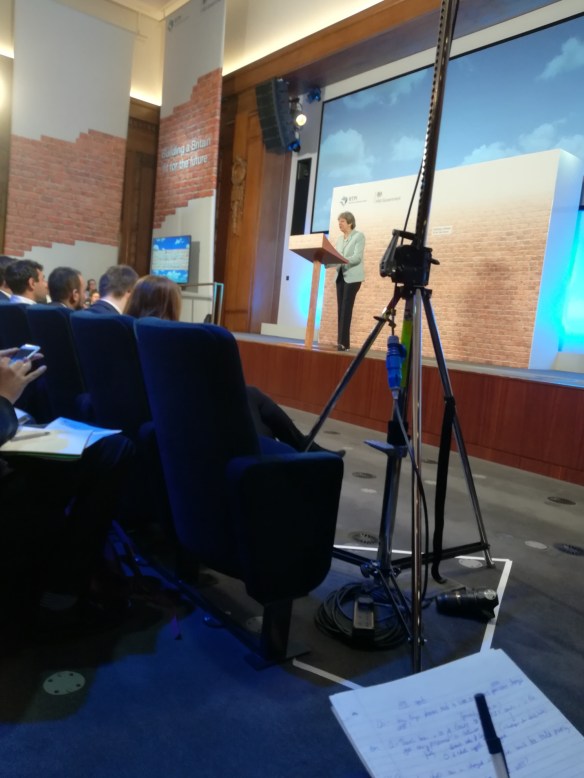
IMG_20180305_103852_resized_20180307_084743602After spending the best part of three hours to travel less than 40 miles (don’t you love rail replacement buses with incredibly unrealistic timetables), I found myself in a slightly surreal position among members of the press with a front row seat for a speech from Prime Minister Theresa May.

I was at a conference jointly organised by the Ministry of Housing, Communities and Local Government and the Royal Town Planning Institute (RTPI) to [re]launch the National Planning Policy Framework. The PM was there to explain how this revised policy would address the national housing crisis. Presumably, I was invited as a long-time RTPI Member and current Chair of their Transport Planning Network.

Not that transport was specifically mentioned by the Prime Minister or Secretary of State, and it was hardly mentioned in the technical sessions or during my casual chats during the long ‘networking’ lunch. I understand it was on at least one slide during the technical session on development locations – my late arrival meant that I had not been able to register for that most popular of sessions – and yet, looking around at people’s badges, I didn’t see job titles suggesting that many transport planners were there to take away any messages that might have been given.

This frustrates me as much as the lack of land use planners at transport events which I have attended in the past year. Transport infrastructure is, more obviously than other types of infrastructure, the warp on which the weft of the built environment is woven. It is the gravy which holds the stew together. Public land, known legally as ‘highways’ that include carriageway, footway, verge, parking spaces, street furniture, and more, make up the majority of what happens in between the private property boundaries, or in other words the ‘buildings’, of our settled, planned places.

And yet the prime minister made far more mention of open space – and preserving the openness of Green Belt land – than she did of the spaces between the 300,000 new houses per year they are planning to build. Perhaps this is because the transport-related changes in the new draft of the NPPF out for consultation are more minor than those relating to the natural environment? It still seemed like there were missed opportunities.

The section in the updated NPPF on sustainable transport is re-structured, with an emphasis on incorporating and engaging with transport planning at the outset, which is encouraging, yet there are no references to the Local Transport Plan or joint spatial plan-making. Some authorities do this anyway, but surely national policy should clearly link the disciplines?

Fortunately, the ill-defined ‘commuter hubs’ proposed in previous consultations are absent, and local discretion is encouraged in identifying places “well served by public transport” to apply density standards. This suggests local transport and land use planners will be given more freedom to decide how to define a transport hub with appropriate capacity and surround it with appropriate development. Unfortunately, local planners are not supported in this endeavour by the barely revised paragraphs in the NPPF on parking. These, whilst less antagonistic about parking charges and enforcement than previously, are more direct with regard to scorning maximum parking standards, despite the success of such policies in the past and the potential for such policies to better provide for a future of electric, potentially autonomous vehicles that are more likely to be shared than owned.

Still, at the conference and in the document, local governments are no longer scapegoats and planners of all types are given more recognition for their ability to create better places. There is even recognition that sustainable transport is about creating “places that are safe, secure and attractive” that “respond to local character and design standards”. And creating such places should be exactly what all planners, transport and land use, are trained to do. There’s still time to do it together a bit more often.

Flexible Resolve

Last month I wrote about the importance of evidence. The month before I wrote about how averages can’t always be used as evidence of what society needs from transport planners. And this month I have even more evidence of how little society may reflect averages.

The University Transport Studies Group annual conference was packed full of papers presenting ongoing or recently completed research from senior academics down to PhD students. The standard was high, and much of the work fascinating. A presentation offering an historic overview of urban transport policy by Professor Peter Jones of University College London best elucidated one conclusion I’ve been coming to over the last year – that we need to move from a ‘Predict and Provide’ to a ‘Vision and Validate’ model. To do this, transport planners must work with other sectors to change how their needs for accessibility can be met in order to meet mobility demand sustainably – and flexibly.

Flexibility is key. People’s need for mobility is dependent upon their need to access activities, goods, and services. As I’ve noted before, more and more people already maintain their accessibility in different ways at different times for different purposes. Their patterns of access can be variable instead of habitual. And between different people or groups of people, there is even more heterogeneity.

For example, there was a presentation on the night-time economy at the conference. I can’t say I’d given much thought to these sorts of workers before. Neither, it turns out, have policy-makers, who have focused on access to places of food, drink, and entertainment for the customers, ignoring those who work in these venues, who might require different travel options than those they serve. Never mind other 24-hour services, such as health and social care, or transport and logistics. How can we envision and plan for transport networks that work for these people, as well as the day-time commuter?

Various presentations also investigated whether ‘Mobility as a Service’ was a realistic scenario for the future of transport. There remain many barriers to its implementation and success. Not least if such services cannot match the flexibility of those most likely to sign on. One paper estimated that Mobility as a Service is of most interest to those who have private vehicles, but only drive their cars 1-2 days a week. Yet as noted in previous blogs, do our current methods of surveying and modelling sufficiently capture such regular, but infrequent behaviours that they enable the design of services catering to these people?

Another paper found that by looking at different data sources and then interrogating the results of one source with the results of the other, travel behaviours that seemed regular and even habitual masked variation. Those who travelled along a stretch of road regularly were more likely to vary their time of travel, whilst those who travelled less regularly were less likely to vary their timing. Getting the right messages out to these irregular travellers, who might not be familiar with their location or choices, is challenging. Yet, it is these people who most need advice, if, as another paper pointed out, they feel they can understand and trust that advice.

Trust is also key for all the ‘shared transport’ that we are apparently ever more willing to use in the 21st century, and, without which, many of our visions for a technologically-advanced, but sustainable future fall apart. However, to note the topic of one final presentation, we would do well to remember that not just vehicles, but roads too are a shared resource. And we don’t always trust each other to use even those flexibly and appropriately!

In conclusion, let’s hope for a New Year that brings not only transport research and policy development that supports flexibility and variation rather than habits and averages, but also a resolve to be a bit more flexible ourselves.


Evidentially, my dear Watson

I recently chaired a panel at the Transport Planning Network’s annual event, which presented evidence on the wider benefits of integrating transport and land use planning to promote sustainable transport. The panel was fairly academic, but the presentations were short, snappy, and discussed their area of evidence at a relatively generalist level. There was little that I hadn’t heard before. The audience was full of transport planners and land use planners working in local government, consultancies, and a few from charities, academia or other non-profit organisations with an interest in transport and land use planning. Before opening the panel for questions from the floor, I asked the audience how many had heard at least one piece of evidence that was completely new to them. The response was surprising. So many hands went up that I couldn’t see whether there were any that remained down.

Sherlock Holmes’ famous catch phrase is a contradiction. His deductions are only elementary if they are sitting on a mountain of evidence, and knowledge about that evidence, such as where the evidence in question was made, under what circumstances, etc. At the transport planning event, it would seem that even professionals in the field are sitting on a mountain of evidence, but have not been given the knowledge to interpret it. Now it may be that many in the audience could interpret portions of the evidence. Maybe they knew what economic agglomeration means for sustainable urban forms, but they didn’t know how physical inactivity causes chronic inflammation. Maybe they knew all about the proportion of greenhouse gas emissions caused by longer distance car trips, but they didn’t realise how that could be translated into proportion of transport emissions from dispersed settlement patterns.

The point still remains that there was something they didn’t know. As another task on my list at the moment is writing an article about sustainable mobility that can be understood by people at graduate level outside the discipline, it raises an interesting question if even those in the discipline don’t know some of the key reasons why sustainable mobility matters. Now, I am tasked more with defining the ‘what’ than describing the ‘why’ in this article, but how much information gives people enough to construct the knowledge on which to act?

Another recent trip I made was to take a short course for post-graduates who want to do a little teaching. In that course, there is some discussion about the need to construct knowledge through active learning. Presenting the information is not enough. For students to be able to incorporate the information into their own body of knowledge, the information needs to be presented in such a way that it builds on what they already know and understand, and they need to be engaged in its exploration through asking questions, discussing its relevance, etc.

For information, substitute evidence. Sure, we had a fairly long Q & A session after the panel presentations, but were more than a dozen people truly engaged in active learning? I asked a simple question about whether any of the information presented was new. I didn’t get to ask them whether anything was partially familiar or how it might relate to what evidence they were already using. Evidence is so important to make the case for sustainable transport, sustainable development, sustainable governance. And that case is mainly being made, not to planning professionals, but to politicians and the public, most of whom are even less likely to be familiar with the academic research in the discipline. So hopefully, the Transport Planning Network event fulfilled its aim to build on evidence that the audience already understood, because only then would they have a chance of applying that evidence to their local projects and passing it on to decision-makers and the public in such a way that sustainability meets acceptability.

Note: The Transport Planning Network is a professional network of over 1600 members administered by the Royal Town Planning Institute and the Transport Planning Society.

Anything but Average

Back in July, I wrote about transport planning for places, rather than individual modes and ‘networks’. Last month, I wrote about transport planning to accommodate the needs of people, rather than the temptations of technology. Last week, I spoke about both at the South West England regional conference for transport planning. Planning, including transport planning, is by definition about looking towards the future and how we create better places than we have now that improve the quality of life for the people in those places.

Yet in preparing my presentation for last week, and in listening to some of the other presentations, I realised that transport modelling, forecasting, and thus planning have yet another loadstone to cast off before they can ‘help shape a better world’, another challenge besides remembering that the best transport planning invisibly serves people and places. And that weight is the weight of averages.

As a methodology for representing individual behaviour, the average, the ‘usual’, falls woefully short. It ignores the steps people may take to be sustainable or exercise more unless they do so more than half the time being measured. It glosses over the people who do not have the same destinations to access on a daily basis. It downplays the regular, but infrequent patterns of linked trips to visit family or participate in other activities that induce diversionary routes once a week or once a month. It gives no thought to how some people may react to increased risk, delay, or disruption due to severe weather, planned events, unplanned incidents, scheduled repair works, or even terrorist threats.

To plan for local contexts, the average assumptions about how people travel to, from, and within areas of particular land uses can easily miss the diversity of options, variety of economic drivers, and cultural preferences in different places. If most traffic and transport models, whether to assess the impacts of new developments or to inform investment decisions with a cost-benefit ratio, are based upon data collected on average dates for an average population and average land uses, it is no wonder that transport planners are still living in a ‘predict and provide’ paradigm. Nor is it surprising that those predictions often turn out to be wrong.

Way back in March, I wrote about Visions of the future of transport and society developed through scenario-planning techniques. I’ve read academic articles advocating scenario planning in order to address the uncertainties we face. But the key to scenario-planning is not only to think about how people behave and how places might take shape, but also to consider a spectrum of possibilities. A spectrum that encompasses extremes, which in turn do allow for hybrid possibilities, but not averages.

This is where big data and new technologies and ‘smart’ infrastructure can help. Algorithms might still regress data back to averages, but that data, those sensors, the digital trail we all leave in our wake like high-tech breadcrumbs , can also give us a much better understanding of extremes than we’ve ever had before. No longer dependent upon snapshots or cross-sections, planners can take a long view and find the patterns of flexibility that better represent the lives we all lead. Instead of predict and provide, let’s propose and future-proof. Because the future is unlikely to be any more ‘average’ than the present.

Air Quality is on Us

The Royal Geographic Society issued a media release on a paper given at their annual conference last week: Study finds impact of road transport on air quality not given sufficient priority in UK transport planning.

The release was picked up by a national newspaper, The Guardian, by the Royal Town Planning Institute’s professional journal, The Planner, and probably plenty of other publications as well. Air pollution may be an unseen killer in our cities, but it is no longer unseen in the media. There was even a headline this week that air pollution is linked to Alzheimer’s Disease. Thus, as Chair of its Transport Planning Network, the RTPI asked me for a response to the academic study to put into The Planner. You can read it here. They cut down the two paragraphs that I sent them, but the first answer that actually came to mind was even shorter:

‘Harsh, but fair.’

If you read my blog, you are already aware that I am a transport planner by choice, career and professional identification. I have worked in both the public and private sectors and am now starting a PhD. First and foremost, I believe in the transformative power of transport planning to create a better society in reality, not just academic theory. So of course I found the conclusion of the study harsh.

However, I am also asthmatic. My asthma is manageable and I have never been hospitalised, but I am more aware than many when warnings of dangerous air pollution are issued. I tend to assume my asthma has more to do with pollen than pollution, having suffered from hayfever for as long as I can remember, yet I also empathise with those whose respiratory conditions are caused by poor air quality. It makes me think it is fair to ask transport planning to do more.

Furthermore, I am part of a small minority of transport planners who has, at some point, worked on the business case for a Low Emission Zone. At the time, I read up on particulates and receptors and undertook a little training on emissions and air quality. I even have the certificate to prove it. Therefore, I understand some of the complexities involved in how the increased use of diesel vehicles can reduce carbon emissions, but increase local air pollution. That’s why I wasn’t surprised by the VW Emissions Scandal last year – as I wrote in my blog at the time, I should have known. And yet, many transport planners aren’t well-informed in the intricacies of air pollution. If any environmental impact is prioritised by policy, it is carbon emissions, which might seem to be addressed by technologies like efficient diesel vehicles. Again, I thought it harsh to expect transport practitioners to manage air quality with neither training nor political support.

On the other hand, making a business case for a new project is a key task in transport planning, so any competent transport planner should be able to uncover the immense cost savings to health budgets of reducing air pollution. Air quality and other public health impacts, incidentally including road safety (pun intended), might take a back seat to carbon emissions and more particularly economic growth in transport appraisal guidance, but one doesn’t have to fully understand the morbidity and mortality calculations of reducing air pollution to achieve a much better benefit to cost ratio. Government may press for new roads and new housing, but transport planners are also taught that it takes good infrastructure for public transport, walking and cycling balanced by restrictions on car use to achieve the environmental, societal and even economic benefits we strive for under the banner of sustainability. So if we aren’t pushing for such policies and action, well, once again criticism is fair enough.

Response to study? Harsh but fair. Recommendation? Transport planners, air quality is on us.


Which Side of the Tracks?

There’s an old way of saying someone is ‘lower class’: they’re said to be from ‘the wrong side of the tracks.’ The saying came from the way that railway lines could sever one neighbourhood from another and designate the residents of one as lesser than those of the other. Railway tracks were symbolic of division.

Division seems to permeate society at the moment. Which side of the tracks someone’s on seems to determine their outlook, their view of any outcomes, even their awareness of what or who might be living on the far side.

This isn’t new, but the UK referendum on the EU has highlighted many divisions in stark relief. Young versus old. Elite versus disadvantaged. Metropolitan versus rural. Local versus Central. Northern England versus Southern England.

Chartered town and transport planners tend to consider themselves a pretty professional and well-educated bunch, but the divisions and the blindness to whoever’s on the other side of the tracks has infiltrated here too.

I was at an event in south Hampshire recently. A presentation on some research by the Royal Town Planning Institute (RTPI) into spatial planning issues for the Northern Powerhouse was, I thought, received with a little too much naivety from some of the southern planners. Perhaps they haven’t been paying attention because the issues are too far away and not part of their day job.

However, they attended the event. There, with a minimal expenditure of time, funds and effort, they were able to educate themselves. Providing such updates and raising awareness is a valuable part of what a professional institute is designed to do.

I also recently attended an interesting workshop on housing development around railway stations. There, I saw divisions between disciplines within our profession. I heard land use planners discussing housing development around railway stations without making any reference to their colleagues’ transport input. There was concern that station regeneration could limit future station expansion, or transport planning for railway capacity might not account for demand created by new housing.

Those from both sides of the planning tracks worried that the processes for building new railway stations and housing developments simply could not be managed in parallel. Local government planners are baffled by rail industry processes. Network Rail is being brought back into central Government, which is also taking responsibility for directly funding housing, yet Government departments are scrambling to keep control in times of unprecedented change.

If the Government is promoting policy to build higher density housing around stations, planners and transport planners at all levels of Government need to work together. Together we can ensure that those new dwellings aren’t severed from each other into the ‘right’ and ‘wrong’ side of the tracks nor from necessary services and employment by the very railway stations and lines that are supposed to be increasing their accessibility.

Such partnership working requires professionals who are well-informed about the roles of their colleagues. That is a key purpose of the Transport Planning Network, a network based in the RTPI, but run in partnership with the Transport Planning Society. I am Chair of this Network and we are organising an event on the topic of development around railway stations. We plan to have case studies from North and South, to have speakers representing the central and the local, and to attract an audience of planners involved in both transport and land use. Let’s build bridges over those tracks.

Flying Solo

Yes, I’m flying solo.

No, I’m not flying to visit American friends and relatives in two weeks and leaving the kids behind. I’ve not suddenly taken up extreme sports or trained as a pilot. Nor did I decide to celebrate my double chai (life) birthday by risking chai and limb going paragliding or skydiving. Nothing so exciting. Instead, one of the most exciting things that happened to me recently was getting my payslip in the post.

I can imagine any reader’s response to that statement. Is it so unusual for a person to receive a payslip in an envelope through their letterbox? Of course not. Personally, I’ve been sent them that way ever since I went on maternity leave. But, and it’s a big but, I’m not on maternity leave anymore. I was serving out my notice period and that was my last payslip from my employer of 8 years.

Then I received another item from my employer in the post. My P45 (tax form) for a leaving employee. It had three pages. One for me and two for my new employer. Except that I don’t have a new employer to give them to. I may not have jumped off a plane, but I have taken a big leap into the unknown.

Am I unemployed then? For the month of August, technically, yes. Although, I would challenge anyone who considers being a mother to two young children a lack of employment. Paid employment, yes. Employment, no. And my children and family needs are a major reason behind my resignation.

However, I plan to do more than be a full-time mum. From September, I’m going to be registering myself with Her Majesty’s Revenue and Customs as self-employed. A sole trader. A freelance transport planner. An independent consultant. My own boss. Flying solo.

My own mother has been telling me to try it for years, but it’s not an undertaking to be taken lightly. There’s a lot more to it than feeling one has the experience to be technically qualified.

I will be required to fill out my own tax returns and pay my own national insurance. I must have professional indemnity insurance and keep my own accounts. I need an online presence, I must market myself, network and use membership to the professional institutions wisely. And yes, it is necessary to make time to work without interruption, which, for me, means initially hiring a childminder one day a week. No matter my intention to work mainly from home, nor how modest my ambitions at present, all these things equate to start-up costs and therefore a commitment to win work to recover those costs.

Then there’s the commitment I’ve made to myself and to the friends, family and former colleagues with whom I’ve shared my plans. They have done me the honour of taking me seriously, so I must pay them due regard by putting in the effort it will require to not only keep up to date with the industry and keep contacts fresh, but also to earn commissions, participate in projects and deliver quality transport planning advice. I have my trepidations, but they believe in my ability to do this and are willing to lend a hand or a kind word or a bit of time or a reference along the way. Perhaps I won’t be flying completely solo on this journey after all.